



The 8 best Attio alternatives (2026), with real costs
Compared on what a team actually pays, outreach and who each tool is best for
The best Attio alternatives in 2026 are Zero, Folk, Clarify, Lightfield, Close, Pipedrive, Affinity and HubSpot. Teams usually leave Attio for one of two reasons: the July 2026 repricing made the bill jump, or they're tired of paying for a separate data provider and sequencing tool on top.
Taru Heikinniemi, Head of Growth· · 15 min read

Pick by how you sell. Zero fits seed to Series A B2B and AI startups that want prospecting, outreach and pipeline on one record. Folk fits relationship-led teams. Clarify fits small, meeting-heavy teams that want a free start. Lightfield fits founders whose deals run through calls. Close fits phone-heavy inside sales, Pipedrive fits teams that want a simple pipeline, Affinity fits VC firms, and HubSpot fits teams whose pipeline comes from marketing.
Shortlist
| Tool | Best for |
|---|---|
| Zero | Seed to Series A B2B and AI startups that want prospecting, outreach and pipeline in one platform, with agents keeping the record current |
| Folk | Relationship-led teams: agencies, partnerships and investors |
| Clarify | Small, meeting-heavy teams that want a free start and unlimited seats |
| Lightfield | Founders whose deals run through meetings and calls |
| Close | Call- and email-heavy inside sales teams |
| Pipedrive | Small teams that want a simple, visual pipeline with no setup project |
| Affinity | VC and private equity firms tracking dealflow and relationships |
| HubSpot | Teams whose pipeline comes from marketing |
| Attio (stay) | Teams that need custom objects and a data model they design themselves |
Why teams leave Attio
Attio is a strong product, and its flexible data model is the reason many teams pick it. The reasons people look elsewhere are mostly about cost and about everything Attio leaves to other tools.
- Prices went up in July 2026. Plus moved from $29 to $35 per seat a month on annual billing, and Pro from $69 to $79. Monthly billing is $44 and $99. Some review sites still show the old prices, so check attio.com before you budget. Attio also bills in euros and pounds: Plus is €31 and Pro €74 per seat a month on annual billing, or £27 and £59.
- Plus stops at 10 seats. The 11th person moves the whole workspace to Pro. On annual billing, that takes a team from $350 a month on 10 Plus seats to $869 a month on 11 Pro seats.
- Outreach sits on Pro. Email sequences and call recording start on Pro. Sourcing new companies and LinkedIn outreach still run through other tools, so most outbound teams pay for a data provider and a sequencing tool next to Attio.
- AI work runs on credits. Each plan includes seat and workspace credits. Extra credits come in packs, starting at $70 a month for 5,000 on annual billing.
- The blank canvas takes work. Attio's flexibility means someone has to design the objects, lists and workflows. Teams switching to Zero tell us setup was the part that never got finished.
The alternatives, one by one
1. Zero
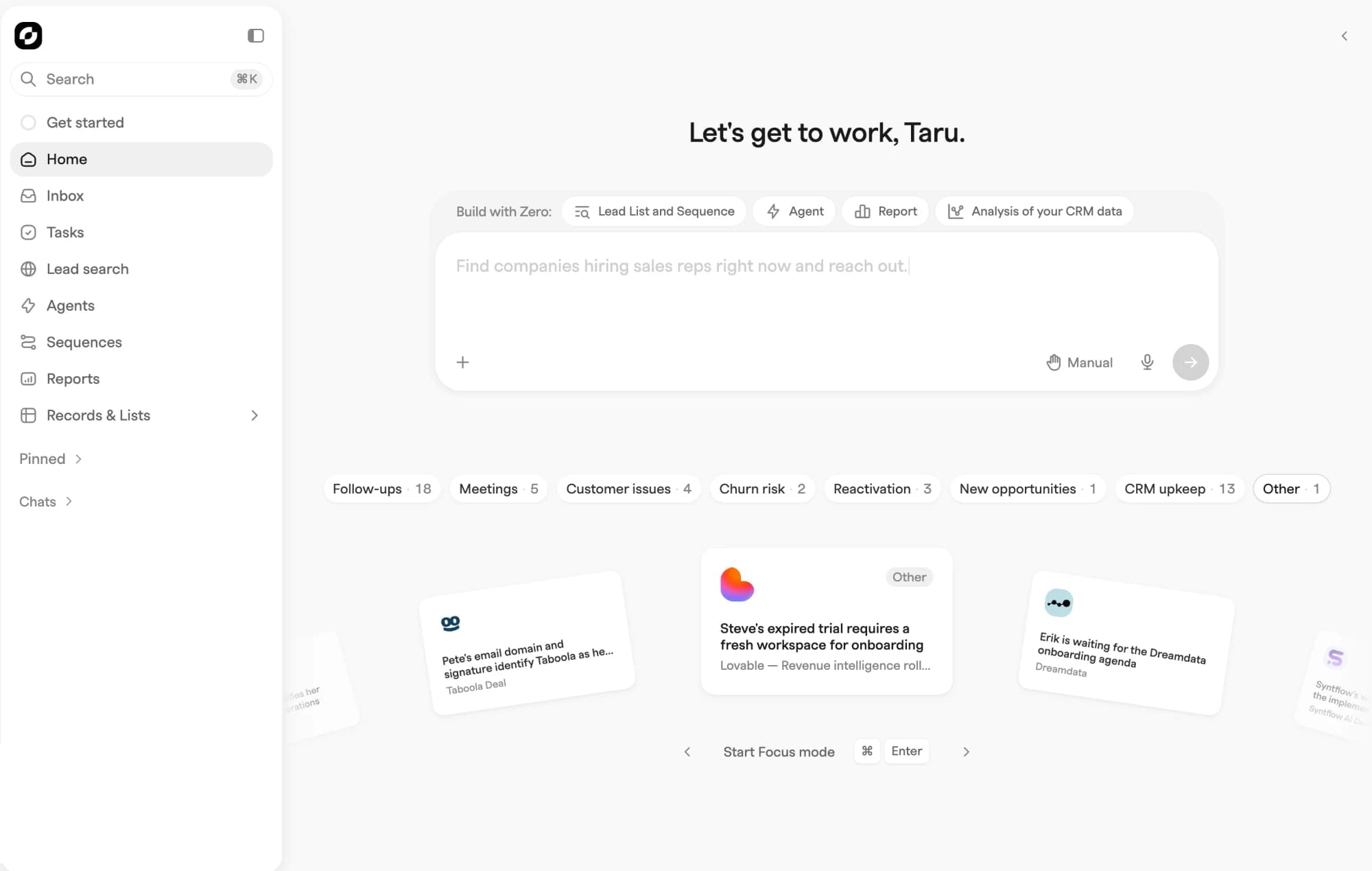
Best for: seed to Series A B2B and AI startups that want prospecting, outreach and pipeline in one platform, with agents keeping the record current.
Zero is an AI-native CRM for startups that replaces the CRM and the tools around it. It includes a full CRM underneath, with the complete customer record, contacts, emails and pipeline, and that is why its agents work. Where an Attio team adds a data provider and a sequencing tool, Zero puts both on the same record.
Pros
- A lead database of more than 350 million contacts with verified contact data, plus enrichment, in the same plan.
- Multichannel sequences across email and LinkedIn, and a dialer, on the same record as the pipeline.
- Agents handle record-keeping and enrichment on their own. Anything that reaches a customer goes through approval, with a full audit trail. Where the line sits.
- One flat seat price with every feature included, and 500 credits per seat a month for enrichment and agent work.
Cons
- No custom objects. This is Attio's biggest edge. Zero covers most cases with custom properties and activities.
- No newsletters or marketing email yet. A tool like Loops covers that alongside Zero.
- A smaller integration ecosystem than Attio's.
Choose it if you run outbound and want sourcing, sequences and pipeline on one record that agents keep current (no manual updating needed). Skip it if your data model needs custom objects, or you have a heavy and long enterprise sales cycle.
Price: Pro is $77 per seat a month on annual billing, or $96 monthly, with a 14-day trial and 2,000 trial credits. No credit card needed. Scale is custom from 10 seats. See Zero pricing.
Switching from Attio: Zero imports your Attio data, so the move starts from your existing records.
More: Zero vs Attio
2. Folk
Folk is the alternative that can feel quite familiar to Attio: clean, contact-centric and quick to adopt. Where Attio asks you to design objects first, Folk starts from the network you already have, synced from email, calendar and LinkedIn.
Best for: relationship-led teams: agencies, partnerships and investors.
Key features
- Contact sync from email and calendar, plus a LinkedIn extension.
- Pipelines, email campaigns and enrichment on Standard.
- Deals, sequences, dashboards, custom objects and the API on Premium.
Pros
- A polished, simple interface that teams adopt fast.
- Light enough for a founder to run alone.
- A low entry price.
Cons
- No sourcing of new companies or contacts, so outbound teams still need a data provider.
- Reporting sits on Premium and is thin for a team that forecasts pipeline.
- AI field fills are metered.
Choose it if you sell through your network and LinkedIn and want something simpler than Attio. Skip it if you need to find new accounts or forecast a pipeline.
Price: Standard $24 and Premium $48 per user a month, billed annually, checked 12 September 2026. No free plan; 14-day trial.
More: Zero vs Folk
3. Clarify
Clarify is one of the newer AI-first CRMs, and its pricing works the opposite way to Attio's. Seats are unlimited on every plan, and you pay for the AI's work in credits rather than per person. The product leans on automation: capturing interactions, preparing meetings, enrichment and record updates.
Best for: small, meeting-heavy teams that want a free start and unlimited seats.
Key features
- An AI sales agent, deal and meeting intelligence, and a call recorder and notetaker on every plan, Free included.
- Advanced enrichment, a LinkedIn integration and up to 2 custom objects on Starter.
- Workspace agents, workflow automation and warehouse access on Growth.
- Campaigns on every plan, from 1 on Free to 20 on Growth.
Pros
- A real free plan: unlimited seats and 1,000 credits a month, with the AI sales agent and call recorder included.
- The whole company can use it without per-seat costs.
- Less manual data entry than Attio out of the box.
Cons
- Every AI action uses credits, so a busy month costs more and is harder to budget.
- Workflow automation starts on Growth, a jump from $40 to at least $1,000 a month.
- A younger product with a smaller ecosystem than Attio's.
Choose it if you want CRM admin automated and a free way to start. Skip it if you need a predictable bill as agent use grows, or a complex data model.
Price: Free with 1,000 credits a month. Starter is $40 a month billed annually, with 5,000 credits a month and larger credit tiers to choose from. Growth starts at $1,000 a month billed annually, with 100,000 or more credits. Enterprise is custom and adds single sign-on. Checked 12 November 2026.
More: Zero vs Clarify
4. Lightfield
Lightfield builds the CRM around conversations. It records meetings and calls, then updates the record from what was said, so nobody types up notes after a call. Unlike Attio, it doesn't ask you to design the system first, though it still offers custom objects.
Best for: founders whose deals run through meetings and calls.
Key features
- A native meeting recorder, transcription and searchable conversation memory.
- Automatic record updates from calls and emails.
- Custom objects and multiple pipelines on every plan.
- Multi-channel sequences, workflows and dashboards on Pro.
Pros
- The strongest meeting capture on this list.
- The closest match to Attio's flexibility among the AI-first tools.
- Unlimited viewer seats on Pro and above.
Cons
- Sequences and workflows start on Pro, at $999 a month per workspace, a big jump from Starter.
- Starter stops at 3 users.
- Credits are annual and don't roll over, and agent work past the allowance bills at an overage rate unless you set a hard cap.
Choose it if your deals happen in meetings and you want the record to write itself. Skip it if you're a small team that also needs outbound, or you need single sign-on without an Enterprise contract.
Price: Starter $89 per user a month, billed monthly, for up to 3 users. Pro $999 a month per workspace, billed annually, with 5 capture seats and unlimited viewer seats. Growth $2,999 a month per workspace, billed annually, with 10 capture seats. No free plan; 14-day trial. Checked 12 November 2026.
More: Zero vs Lightfield
5. Close
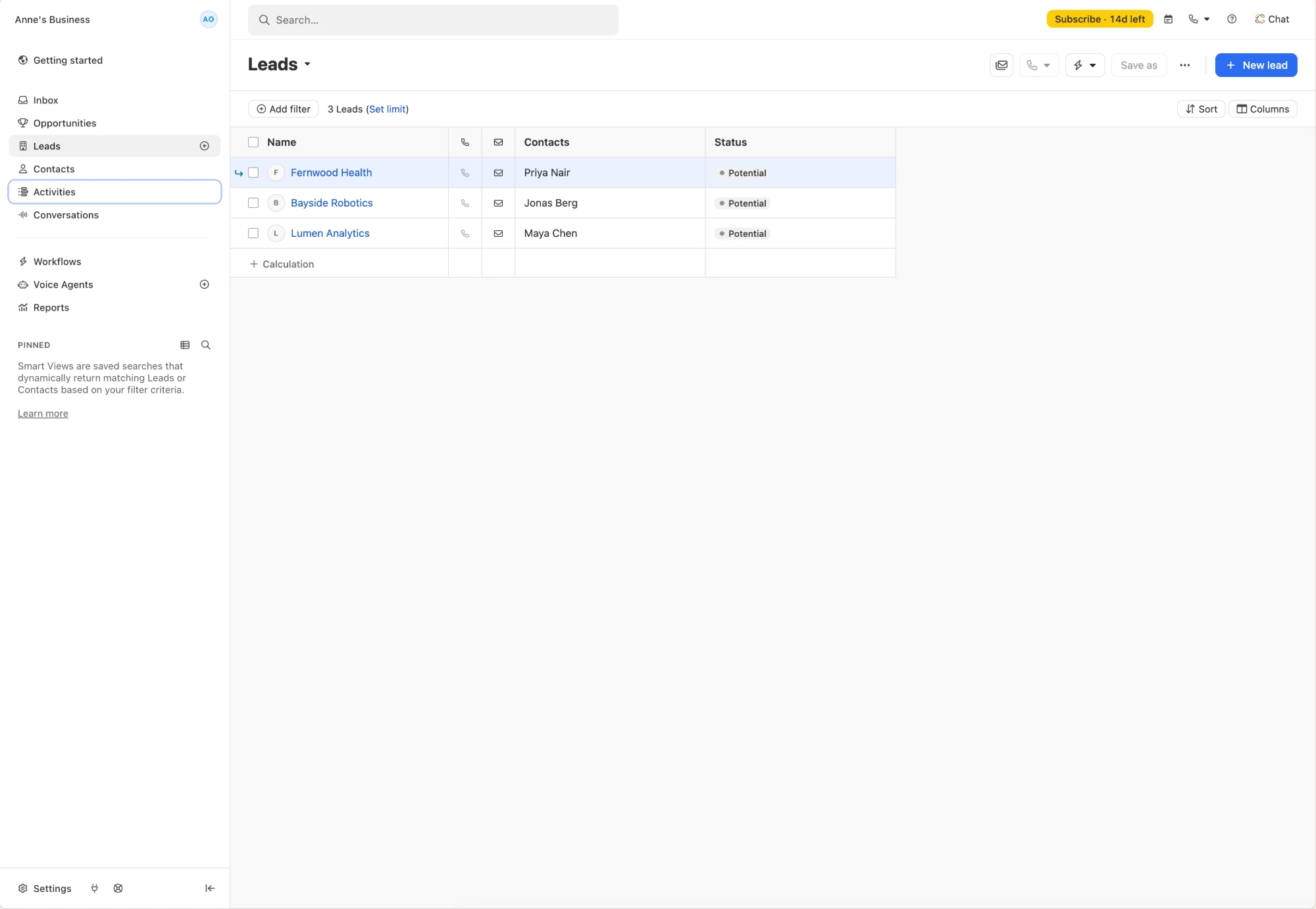
Close is built around the phone. Calling, email, SMS and sequences live in one tool, so an inside sales team doesn't need a separate dialer or sequencing product. It trades Attio's flexible data model for speed: there is little to configure before reps start dialling.
Best for: call- and email-heavy inside sales teams.
Key features
- Built-in calling, email and SMS.
- A Power Dialer on Growth and a Predictive Dialer on Scale.
- Sequences on the same record, and automated workflows from Growth.
- Chloe, an AI sales agent, on every plan, with AI credits from 500 per user a month on Solo to 2,000 on Scale.
Pros
- Replaces the dialer and sequencing tools an Attio team usually adds.
- Fast to set up; reviewers often say it needs little training.
- Low entry pricing for a solo founder.
Cons
- Built for sales only. Marketing and support features are thin.
- Not designed for custom data structures beyond the sales process.
- Calling minutes, SMS and phone numbers cost extra on top of seats.
- No free plan.
Choose it if your reps live on the phone. Skip it if you need a CRM for several teams or a flexible data model.
Price: Solo $9, Essentials $35, Growth $99 and Scale $139 per seat a month, billed annually. Telephony usage is billed separately. Checked 12 November 2026.
6. Pipedrive
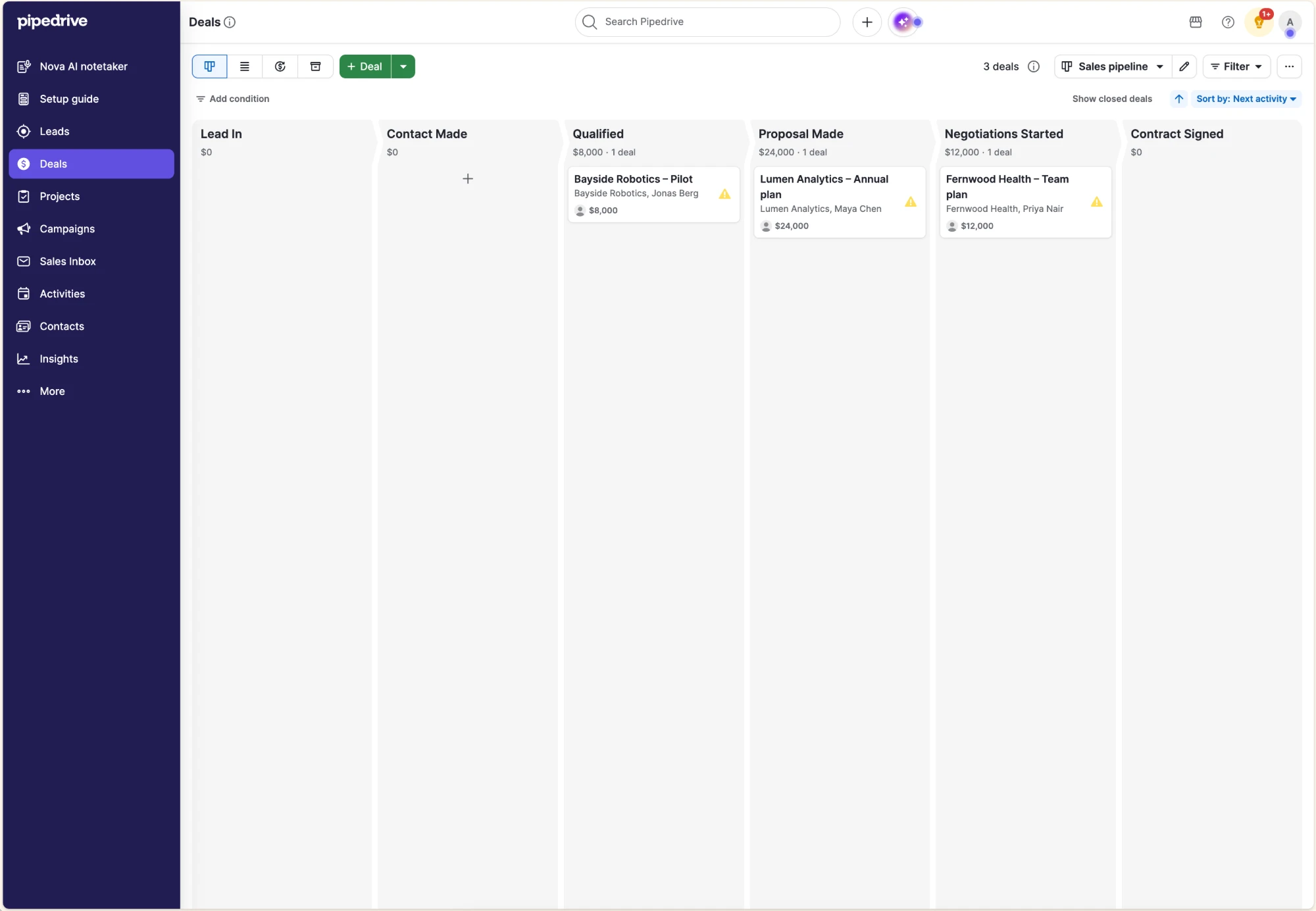
Pipedrive is a pipeline tool, not a relational database. You give up Attio's flexible objects and get a system a sales team can run on day one without anyone modelling anything. Deals, next actions and sales reports come pre-structured.
Best for: small teams that want a simple, visual pipeline with no setup project.
Key features
- A visual, drag-and-drop pipeline with activity reminders.
- Email sync and workflow automations from Growth.
- Prospecting add-ons (LeadBooster) and Projects included from Premium.
- AI report creation on every plan, and AI email tools from Premium.
Pros
- One of the easiest pipelines to set up and read.
- A low entry price.
- A large marketplace of integrations and add-ons.
Cons
- Reps still type most updates by hand.
- Lite has no email sync or automations, so most teams end up on Growth.
- No custom objects at any tier.
- The bill climbs with add-ons for email, documents and lead generation.
Choose it if you run a standard sales pipeline and Attio felt like more system than you need. Skip it if your data goes beyond deals, or you want the record kept up to date for you.
Price: $14 to $79 per seat a month on annual billing, from Lite to Ultimate, or $24 to $99 monthly. No free plan; 14-day trial. Checked October 2026.
More: Zero vs Pipedrive
7. Affinity
Affinity is a CRM built for private capital: venture capital, private equity and investment banking. It captures every email and meeting across the firm and scores relationship strength, so a partner can see who has the warmest path to a founder. Attio can be configured to run a fund too; Affinity does it out of the box.
Best for: VC and private equity firms tracking dealflow and relationships.
Key features
- Automatic email and calendar capture, relationship scoring and deal pipeline tracking on every tier.
- A meeting notetaker, AI chat across your pipeline and network, and an MCP server on Scale.
- Enrichment from PitchBook, Dealroom and Crunchbase, plus workflow automations, on Advanced.
Pros
- Built around dealflow, portfolio companies, LPs and co-investors, not sales pipelines.
- Relationship intelligence across the whole firm's network.
- No setup fee.
Cons
- Priced per user per year from $2,000, more than twice Attio Pro per seat.
- Built for dealflow, not for running outbound sales.
Choose it if your network is your sourcing edge. Skip it if you're a small fund watching costs, or your team runs a sales motion.
Price: Essential $2,000, Scale $2,300 and Advanced $2,700 per user a year, billed annually. Enterprise is custom. No free plan. Checked 12 November 2026.
8. HubSpot
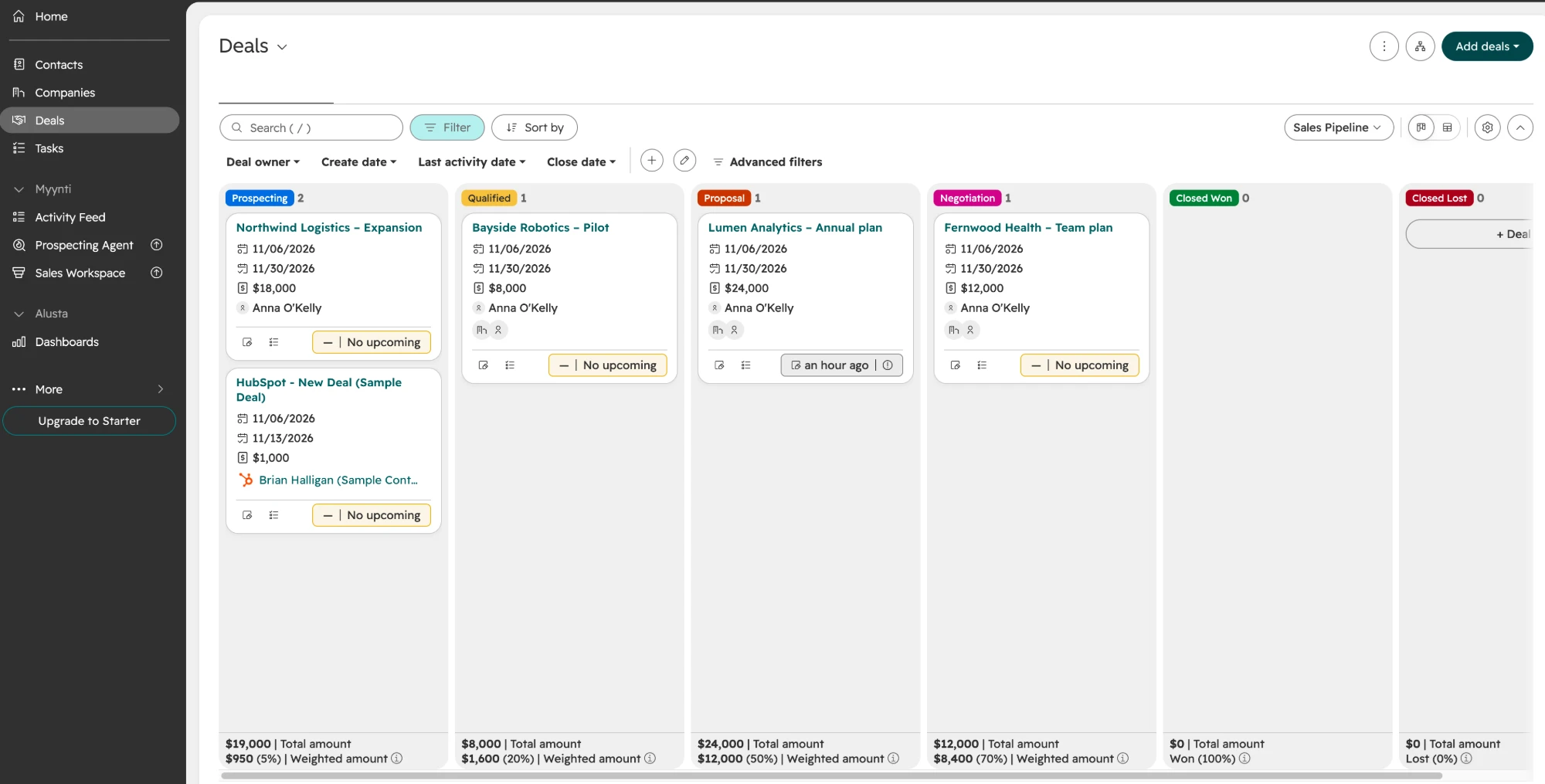
HubSpot is a full customer platform rather than a standalone CRM. Marketing, sales and service share one contact record, which Attio doesn't try to offer. The trade-off is weight: more hubs and settings to manage, and the sales features most teams want sit on higher tiers.
Best for: teams whose pipeline comes from marketing.
Key features
- Marketing Hub for email, forms, campaigns and lead scoring.
- Sequences and forecasting in Sales Hub from Professional.
- Breeze AI agents across the hubs.
- More than 2,000 integrations.
Pros
- The deepest marketing suite on this list.
- A free CRM for up to 2 users.
- Eligible funded startups get up to 90% off Professional and Enterprise in year one.
Cons
- Sequences start on Sales Hub Professional, at $90 per seat a month annually plus a one-time $1,500 onboarding fee.
- The startup discount steps down to 50% in year two and 25% in year three, then ends.
- Custom objects are gated to the top tier, where Attio includes them on every paid plan.
- Reps still update most records by hand. Breeze AI is built on top of the existing platform, not AI-native from the ground up.
Choose it if marketing drives your pipeline and you want marketing and sales on one record. Skip it if you're an outbound-led startup, or you need flexible objects without an Enterprise contract.
Price: Starter from $7 per seat a month annually ($20 list). Professional $90 per seat a month annually ($100 monthly), plus $1,500 onboarding. Checked 9 October 2026.
More: Zero vs HubSpot and HubSpot pricing explained
When to stay on Attio
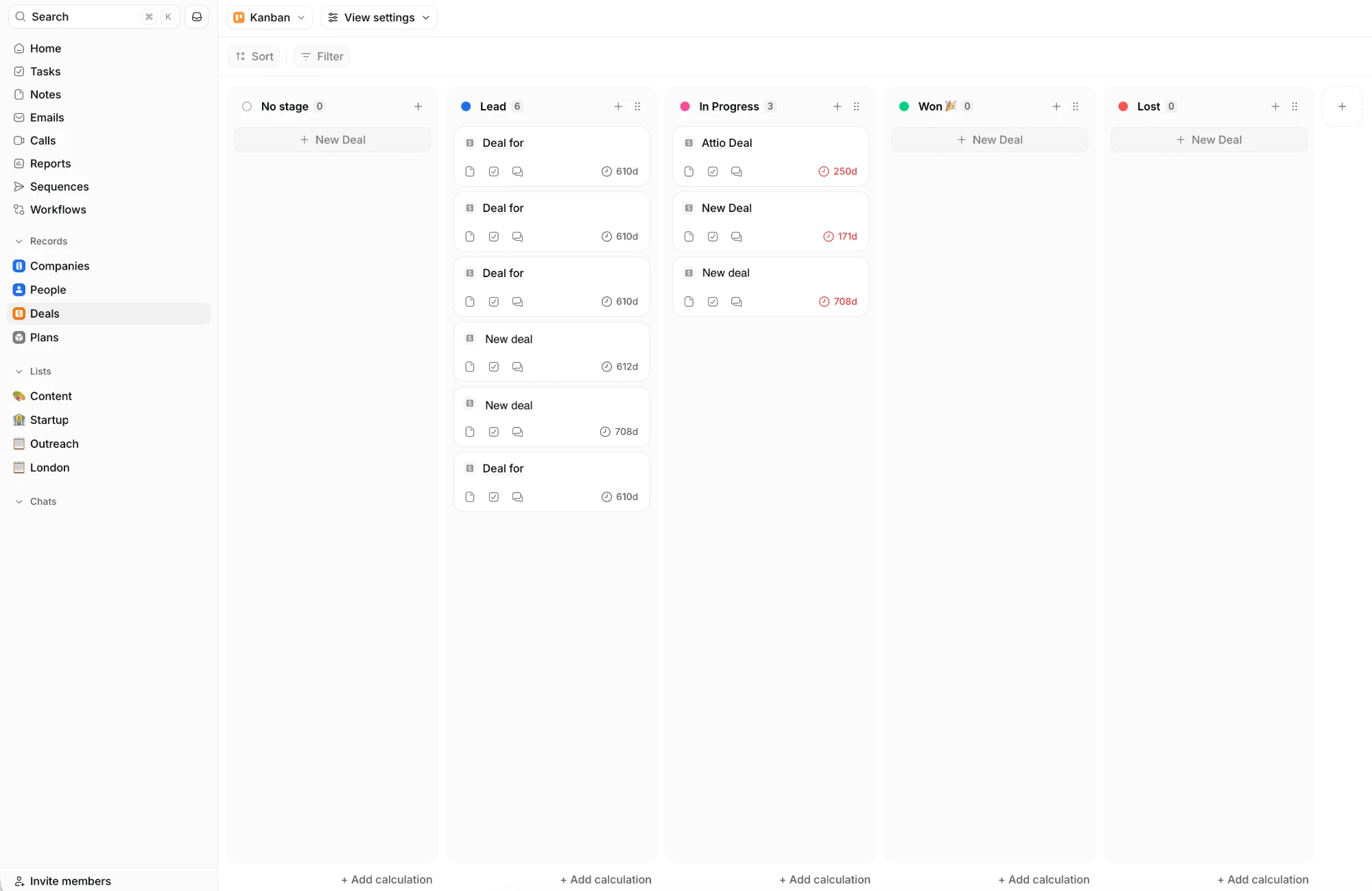
Stay on Attio if your data model is unusual and you need custom objects, or if you're a team of 3 or fewer and the free plan covers you. Attio also suits larger, mid-market teams that want a configurable database and a mature integration ecosystem.
Some reasons for leaving aren't CRM problems at all. If you hit credit limits on high-volume automation, moving that automation to a dedicated tool alongside can help you, and if you mainly need enrichment, Clay connects to Attio directly, but increases costs significantly. Switching makes sense when the gap is the selling work itself: sourcing, sequences and keeping the record current.
What a 5-person outbound team actually pays
Entry prices mislead, because most CRMs on this list need a data provider next to them before a team can run outbound. This table prices the whole setup for 5 sellers on annual billing, using Apollo Basic ($49 per seat a month) as the data and sequencing tool where the CRM doesn't include one. It leaves out LinkedIn tools, extra credit packs and tax.
| Setup | What's included | Per year |
|---|---|---|
| Folk Standard + Apollo Basic | Folk $1,440 + Apollo $2,940 | $4,380 |
| Zero Pro | Lead database, email and LinkedIn sequences, dialer, 500 credits per seat a month | $4,620 |
| Attio Plus + Apollo Basic | Attio $2,100 + Apollo $2,940 | $5,040 |
| Attio Pro + Apollo Basic | Attio $4,740 + Apollo $2,940 | $7,680 |
| HubSpot Sales Hub Pro + Apollo Basic | HubSpot $5,400 + $1,500 onboarding + Apollo $2,940, year one at list price | $9,840 |
| Lightfield Pro + Apollo Basic | Lightfield $11,988 for 5 capture seats + Apollo $2,940 | $14,928 |
| Attio Plus, no outbound | CRM only, no data provider | $2,100 |
Folk plus Apollo is the cheapest outbound setup on paper, by $240 a year. Zero is the only setup where the lead data, sequences and pipeline share one record, so nobody syncs contacts between two tools. HubSpot's startup discount can cut its year-one cost sharply for eligible funded startups.
How to switch off Attio
- Export your records and lists. Attio exports any view or list as a CSV or Excel file on every plan, and a workspace backup downloads your lists and attributes as CSV files in one zip. On Enterprise, admins can restrict exports, so check who has access first.
- Know what stays behind. Attio's enriched data can't be exported, only the data your team entered. Call recordings export as metadata only, without audio or transcripts. CSV exports also flatten links between records into plain columns; the API keeps them if you need them.
- Map custom objects before you import. Decide where each custom object lives in the new tool. In Zero, that usually means custom properties or custom activities.
- Clean up, then import. Remove duplicates and stale records first, so the new system starts tidy. Zero imports Attio data, and its agents enrich records after import, which replaces the enrichment you can't take with you.
- Keep Attio read-only for a short overlap. Check that pipeline, owners and open deals match before you cancel.
"We moved from Attio to Zero, the migration was so fast. I think I clicked like 3 buttons." Yahia Bakour, Founder at Context.dev
Full comparison
Entry prices are per seat a month on annual billing unless noted, checked between September and November 2026.
| Tool | Best for | Entry paid price | Built-in outreach | Free plan |
|---|---|---|---|---|
| Zero | Prospecting, outreach and pipeline in one platform | $77 (Pro) | Lead database, email and LinkedIn sequences, dialer | No, 14-day trial |
| Attio | Custom data models | $35 (Plus) | Sequences on Pro; sourcing and LinkedIn through other tools | Up to 3 seats |
| Folk | Relationship-led teams | $24 (Standard) | Sequences on Premium; no sourcing | No, 14-day trial |
| Clarify | Meeting-heavy small teams | $40 a month (Starter, unlimited seats) | Campaigns, credit-metered | Yes, unlimited seats |
| Lightfield | Meeting-led selling | $89 (Starter, up to 3 users) | Multi-channel sequences from Pro ($999 a month) | No, 14-day trial |
| Close | Inside sales, calls and email | $9 (Solo) | Calling, email and SMS | No |
| Pipedrive | Simple visual pipeline | $14 (Lite) | Email sync and automations from Growth | No, 14-day trial |
| Affinity | VC and PE dealflow | $2,000 per user a year (Essential) | Relationship tracking, not sales sequences | No |
| HubSpot | Marketing-led pipeline | $7 (Starter, $20 list) | Sequences from Professional ($90) | Up to 2 users |
Frequently asked questions
What is the best Attio alternative?
Is Zero cheaper than Attio?
Does Zero have custom objects like Attio?
Can Zero replace Attio plus Apollo or Clay?
Why did Attio's prices go up?
Is there a free Attio alternative?
Is there an open-source Attio alternative?
Is Attio good for startups?
Can I export my data from Attio?
Is Zero a CRM?
Attio pricing checked against attio.com/pricing between 6 and 11 November 2026. Other vendors' prices and features checked on their own sites between September and November 2026, and dated in each tool's price line. Vendors change plans often, so check before you buy.
About the author
Taru Heikinniemi, Head of Growth at Zero
Taru Heikinniemi has spent her career working as a CRM consultant and leading growth at early-stage companies, and she has advised startups and scaleups on go-to-market, tech stacks and martech. She's set up, run and rescued more CRMs than she'd like to admit, and now helps startups pick the one their team will actually keep current.